In today’s regulatory environment, financial institutions need surveillance professionals who are equipped with the right product, asset class, and market surveillance expertise.
One weak link — an outdated understanding of your trading profile, relying on legacy/inherited knowledge, over-reliance on your surveillance vendor solution to fill the expertise gap — can expose your institution to significant risk, reputational damage, and regulatory action.
Technology is only as effective as the people interpreting the alerts it generates. “AI” is not a replacement and does not help analysts become better at surveillance. Ongoing, rigorous evaluation and upskilling of your surveillance function is no longer optional—it’s critical.
While training options in market surveillance have historically been limited, that’s no longer the case. With us, firms now have a clear training opportunity, with no excuse for failing to invest in the capability and confidence of their surveillance teams.
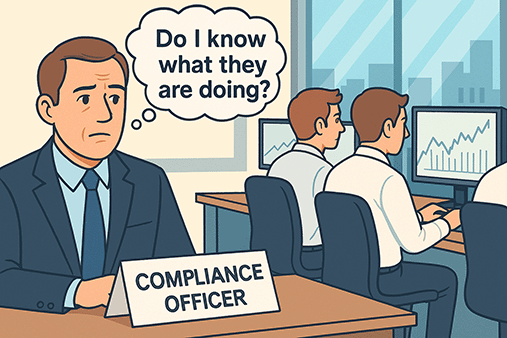
One of the biggest gaps in surveillance is understanding the trader’s (or client) world — how they take risk, what they use, and why certain behaviours make sense in context.
The sharper that understanding, the easier it is to break down and manage the grey area, making clearer the line between routine, risky, and abusive.
Recognising the nuances across your trading universe has a direct impact on alert quality and alert volume, where nuance can take the form of:
A market surveillance analyst trying to escalate a complex case to a front-office trader or compliance officer… but not having the right context, vocabulary, or credibility — so the message gets lost.
Or offshore teams communicating with onshore stakeholders, where cultural, technical, or product knowledge gaps create friction or misalignment.


Whether you’re managing onshore/offshore Market Surveillance Teams, overseeing compliance or undertaking testing/audit reviews, we provide IN-PERSON and REMOTE ONLINE practical and relevant training.
Our Trade & Conduct Surveillance Training programme covers practitioners, advisors, consultants and RegTech providers.
Build expertise in trade flows, surveillance risks, and regulatory requirements to ensure teams can identify and escalate risks efficiently. Learn to join the dots with our T³ framework and uncover the context.
Keep first-line supervisors and business compliance officers and audit staff up to date on evolving surveillance requirements and best practices. Remove the “chicken talking to a duck” scenario.
Upskill consultants in trading and surveillance knowledge so they can provide high-value advisory services to financial institution clients. Know your customer by internalising their environment.

Elevating Conduct Surveillance Excellence Across Your Organization
Get in touch with us via phone, email, or WhatsApp
UK +44 203 951 1803
SG +65 8788 3314
email : care@conductsurveillance.com